About
I am an archaeologist and historian specialising in personal ornaments, identity, craft technologies, and material culture in prehistoric Anatolia and the wider Mediterranean.
My research begins with small objects: beads, shells, pendants, bone plaques, and other forms of body adornment. These objects were worn on bodies, exchanged between people, placed with the dead, and passed through moments of learning, care, memory, and transformation. By studying how they were made, used, worn, repaired, and deposited, I explore how prehistoric communities expressed who they were and how they related to others.
I received my PhD in Prehistoric Archaeology from Istanbul University in 2022. My doctoral research focused on funerary beads from Aşıklı Höyük, one of the earliest sedentary communities in Central Anatolia. Through microscopic use-wear analysis and contextual study, I examined how ornaments helped shape and communicate age, gender, personhood, and social identity during the early Neolithic.
Since 2013, I have worked at Aşıklı Höyük and contributed to research on early village life, architecture, childhood, craft, burial practices, and the social worlds of Neolithic communities. My broader work combines archaeology, anthropology, gender studies, material culture studies, and experimental approaches to craft practices.
After completing my PhD, I worked at the University of Bordeaux on the evolution of prehistoric ornaments in western Asia. I later joined the National Geographic Society-funded project Small Things, Big Stories: Embodying Prehistoric Identity in Turkey. In 2024-2025, I was an ANAMED Postdoctoral Fellow at Koç University, where I studied how symbolic objects helped create lasting connections between people, places, and memories during the transition to sedentary life.
I am currently a TÜBİTAK Postdoctoral Fellow at Bilkent University. My project, “Pre-Crafts,” investigates body adornment technologies, craft specialisation, and social identities in Anatolian prehistory.
Alongside research and fieldwork, I teach and write for broader audiences. I am especially interested in making archaeology accessible beyond specialist circles, and in showing how very old objects can help us think about identity, memory, care, and belonging today.
Career Timeline
A Family Object, A Research Question
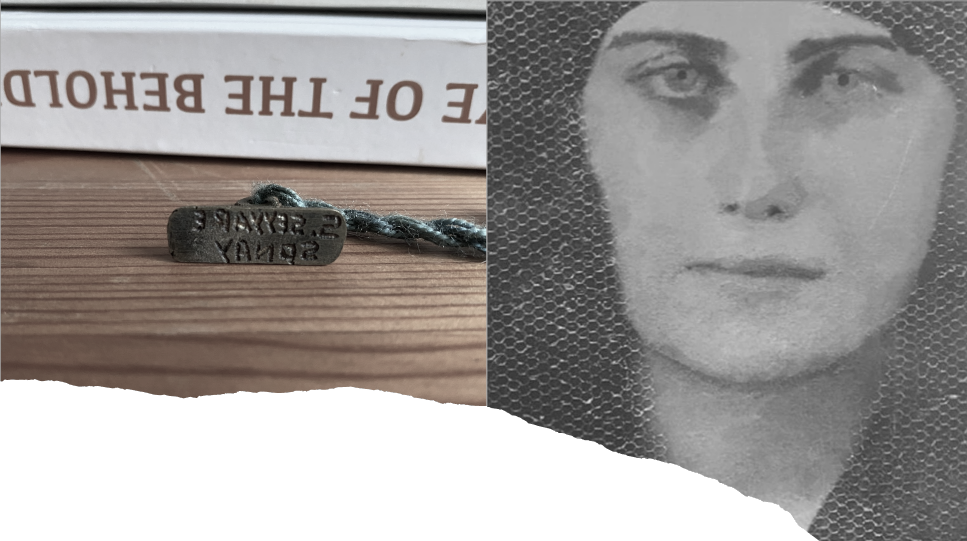
My great-grandmother's stamp-seal
One of the questions at the heart of my research begins with a family object: a small perforated stamp seal used by my great-grandmother, Seniye Seyyare Sonay, in early twentieth-century Trabzon. Although she could not read or write, she marked documents with this object instead of a signature. Passed down through four generations of women in my family, the seal became more than a practical tool; it became a material trace of memory, identity, and continuity. This story shapes my archaeological work. I study personal ornaments and symbolic objects to ask how small things hold relationships across time, and how objects helped people in prehistoric Anatolia remember, belong, and become who they were.
My archaeological work begins in the field, but it often continues under the microscope...
Since 2013, I have worked on excavation, survey, and laboratory projects across Türkiye, with a particular focus on Neolithic and Epipalaeolithic personal ornaments. These projects have taken me from early village sites in Central Anatolia to survey landscapes, laboratories, and museum collections. I am especially interested in what happens when excavation context and close material analysis are brought together. A bead is never only a bead: it may carry traces of production, use, repair, movement, burial, memory, and touch. My field and laboratory work asks how ornaments moved between bodies, houses, graves, landscapes, and communities, and how these movements shaped social life.
From Field to Microscope
My work combines excavation experience with the specialist analysis of personal ornaments. In the field, I work with the spatial and contextual lives of objects: where they are found, what they are associated with, and how they relate to architecture, burials, and daily practices. In the laboratory, I examine how ornaments were made and used. Through macroscopic study and microscopic use-wear analysis, I look for traces of manufacture, stringing, suspension, polishing, breakage, repair, and long-term handling. These details help reconstruct the biographies of objects: how they were transformed from raw materials into meaningful things.