2026–present · TÜBİTAK Postdoctoral Fellowship, Bilkent University
PRE-CRAFTS: Body Adornment Technologies, Craft Specialisation, and Social Identities in Anatolian Prehistory
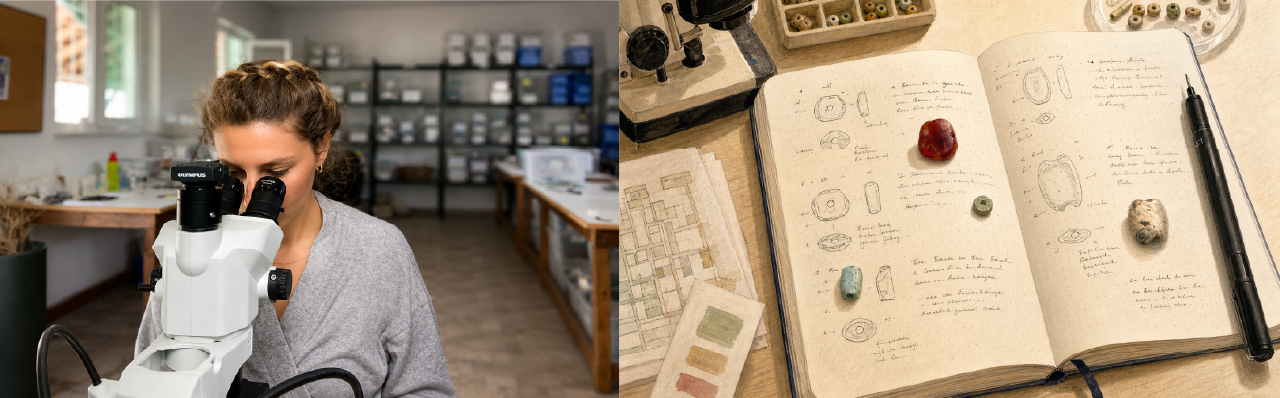
Observing a Neolithic bead under the microscope at Aşıklı Höyük, Aksaray, Türkiye (left) and an illustration of my initial notes with pen and paper (right)
Objectives
In my current project, I investigate the interplay between body ornamentation technologies, craft specialisation, and social identities in Anatolian prehistory through an interdisciplinary lens. I have three core objectives: reconstructing ornament production techniques and their degree of standardisation; reconstructing ornament use and adornment practices; and reinterpreting craft specialisation and social identities in Anatolian early prehistory.
Methods
Analysing ornaments from Late Epipalaeolithic and Neolithic sites in Anatolia, I combine experimental archaeology, morphometric analysis, microscopic use-wear analysis, and multivariate statistics, interpreting the results within anthropological frameworks on craft specialisation and identity.
Host Institution
The project is conducted at Bilkent University, Department of Archaeology, in collaboration with the National Nanotechnology Research Centre and follows an ethical, sustainable sampling protocol aligned with Türkiye's heritage protection policies.
2024-2025 · ANAMED, Koç University
Objects of Memory: Symbolic Item Depositional Practices at the Dawn of Sedentism in Anatolia
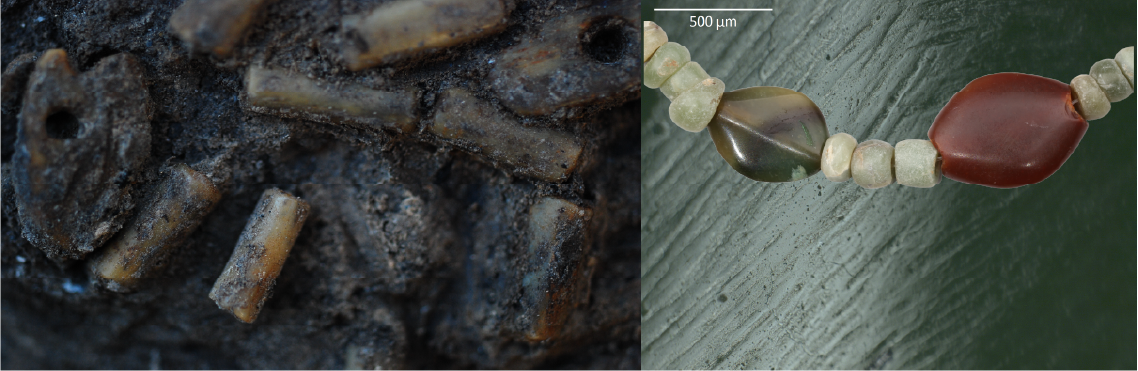
Neolithic bone (left) and stone beads (right).
In the background is what I often see under the microscope: polish and striations left by wear (Aşıklı Project Archive & S. Yelözer)
My ANAMED postdoctoral fellowship examined how symbolic and decorative objects helped create durable connections between people, places, and memories during the transition to sedentary life in Neolithic Anatolia, focusing on the neighbouring early village sites of Aşıklı Höyük and Balıklı.
Project results
The project results will be published very soon! In the meantime, you can read my project report on the ANAMED website.
2023 · AKMED Project Grant, Koç University Suna & İnan Kıraç Research Centre for Mediterranean Civilisations
Stone Bead Production and Use in Prehistoric Anatolia: An Experimental Approach

Making an experimental Neolithic bead (featured is the hand of experimental archaeologist U. Cumali, photo: S. Yelözer)
This project investigated how prehistoric stone beads were made and used through experimental archaeology. Funded by an AKMED 2023 Project Grant, the project focused on reconstructing bead production techniques, use-wear traces, and the practical knowledge involved in transforming stone into personal ornaments. By experimenting with production and use, the project created a comparative framework for interpreting archaeological bead assemblages from prehistoric Anatolia. It also helped connect microscopic traces on prehistoric ornaments with the gestures, tools, skills, and decisions involved in making and wearing them.
2023-2026 · National Geographic Society-funded project · PI: Dr Emma Baysal
Small Things, Big Stories: Embodying Prehistoric Identity in Turkey
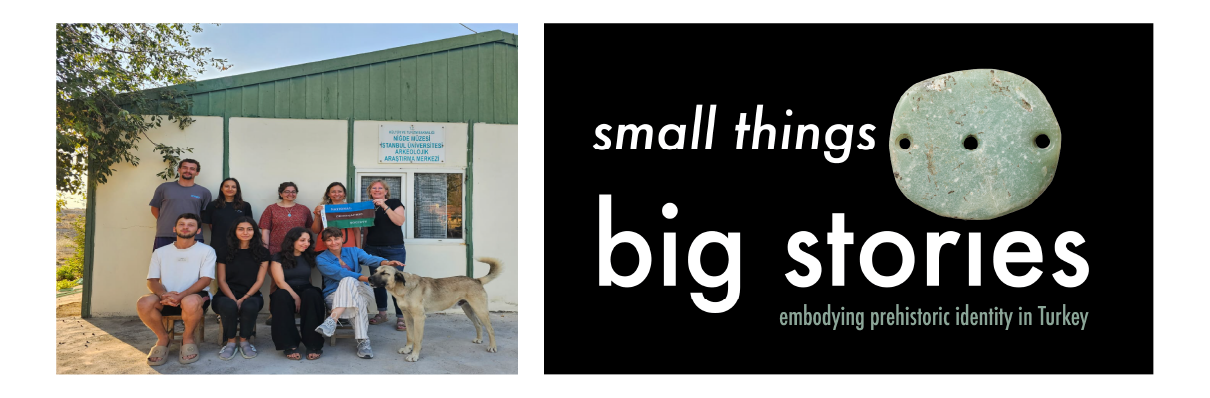
The 'Small Things, Big Stories' Project and our visit to Sırçalıtepe in 2024, a Neolithic site in Cappadocia (left)
The "Small Things, Big Stories" Project was funded by the National Geographic Society and led by Dr Emma Baysal (Bilkent University). As a postdoctoral researcher on the project, I analysed bead assemblages from prehistoric sites in Türkiye and worked on disseminating the results, exploring how small, personal objects embodied identity in prehistoric Turkey. I also oversaw project website management and regularly contributed updates and articles to the project's blog, website, and social media channels. Check the project’s website for more information.
Project results
One of the outcomes of this project was an article titled "Bodies and behaviours: archaeological material culture and the interpretation of identity at the Neolithic transition", published in the peer-reviewed Springer volume Weaving and Wearing Identities: Personal Adornment in Past Societies. In this article, we used a conspectus of research on Neolithic body-artefact relations to ask what theoretical and interpretive frameworks have been used to approach the question of identities in the archaeological record of Western Asia.
2022-2023 · CNRS & Université de Bordeaux, UMR 5199 PACEA
Out of the Core: Exploring Social Networks at the Dawn of Agriculture in Western Asia
As a researcher, I worked on data collection and database management for the "Out of the Core: Exploring Social Networks at the Dawn of Agriculture in Western Asia" project, led by Dr Solange Rigaud (CNRS), which traced the evolution of prehistoric ornaments across western Asia.
2016-2022 · Istanbul University
PhD Research: Identities at Aşıklı Höyük

My workstation at Aşıklı Höyük
My doctoral research, "Detecting Individual and Collective Identities during the Early Neolithic: Gender, Age, and the Intersectionality of Identities at Aşıklı Höyük," examined how identities were displayed and negotiated during the onset of sedentary life in Central Anatolia. Using the funerary bead assemblages of Aşıklı Höyük as my core case study, I combined microscopic use-wear analysis with contextual and gender-archaeology approaches to explore how ornament production and use intersected with age, sex, and social identity. As part of this research, I held visiting fellowships at CNRS & Université Côte d'Azur (Nice) and the University of Edinburgh, funded by the American Research Institute in Turkey (ARIT).